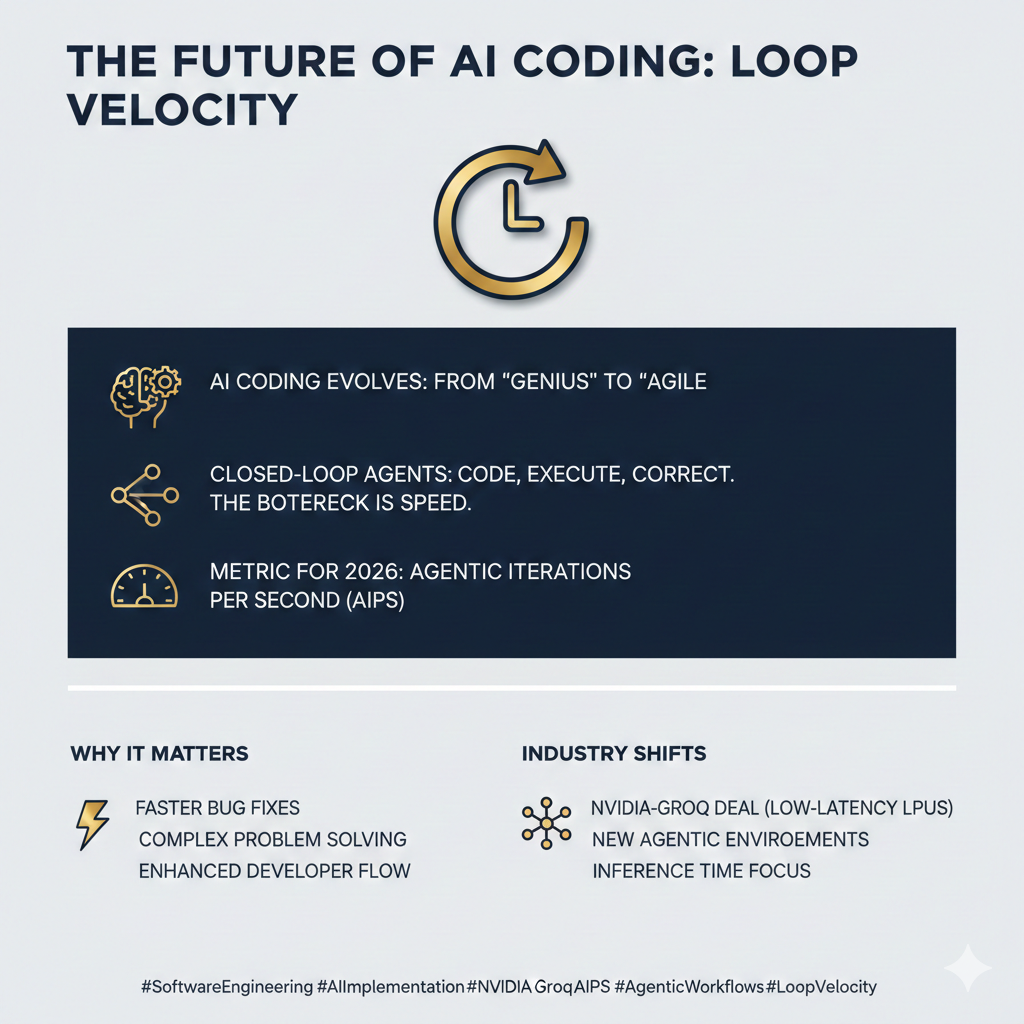
Prediction for 2026: For AI Supported Coding, the "Loop Velocity" will become a key differentiator. With closed-loop agents like Claude Code or Antigravity, the AI doesn't just write code; it executes, identifies errors, and self-corrects.
The bottleneck is no longer the model’s raw intelligence—it’s the clock rate of the loop. How fast can the model iterate over attempts and test if it succeeded? Speed becomes a form of Intelligence: A "good" model that fails fast and self-corrects multiple times per minute will solve complex bugs that a "genius" model with high latency never reaches.
For these systems, Agentic Iterations per Second (AIPS) - or rather minute for now - will become a key feature. With CI/CD set up properly, the model can quickly test if the written code works - are all unit tests green? Does the UI behave as defined?
Many indications exist. Changed behavior and expectations from developers, more focus on inference time behavior of models, the NVIDIA-Groq deal (integrating Groq’s ultra-low latency LPU architecture), new features in Agentic Coding environments.
Even without fully closed agentic loops, waiting times for agentic coding solutions are critical. Engineers report frustration from lengthy waiting times, a loss of "flow" with fragmented focus. Maybe worth another reflection.