Almost three years ago I did a little experiment: What is the effect of AI on Journalism? How easy is it, too create vaguely accurate information that looks professional, yet is totally trembling at the slightest touch - or even is plain wrong.
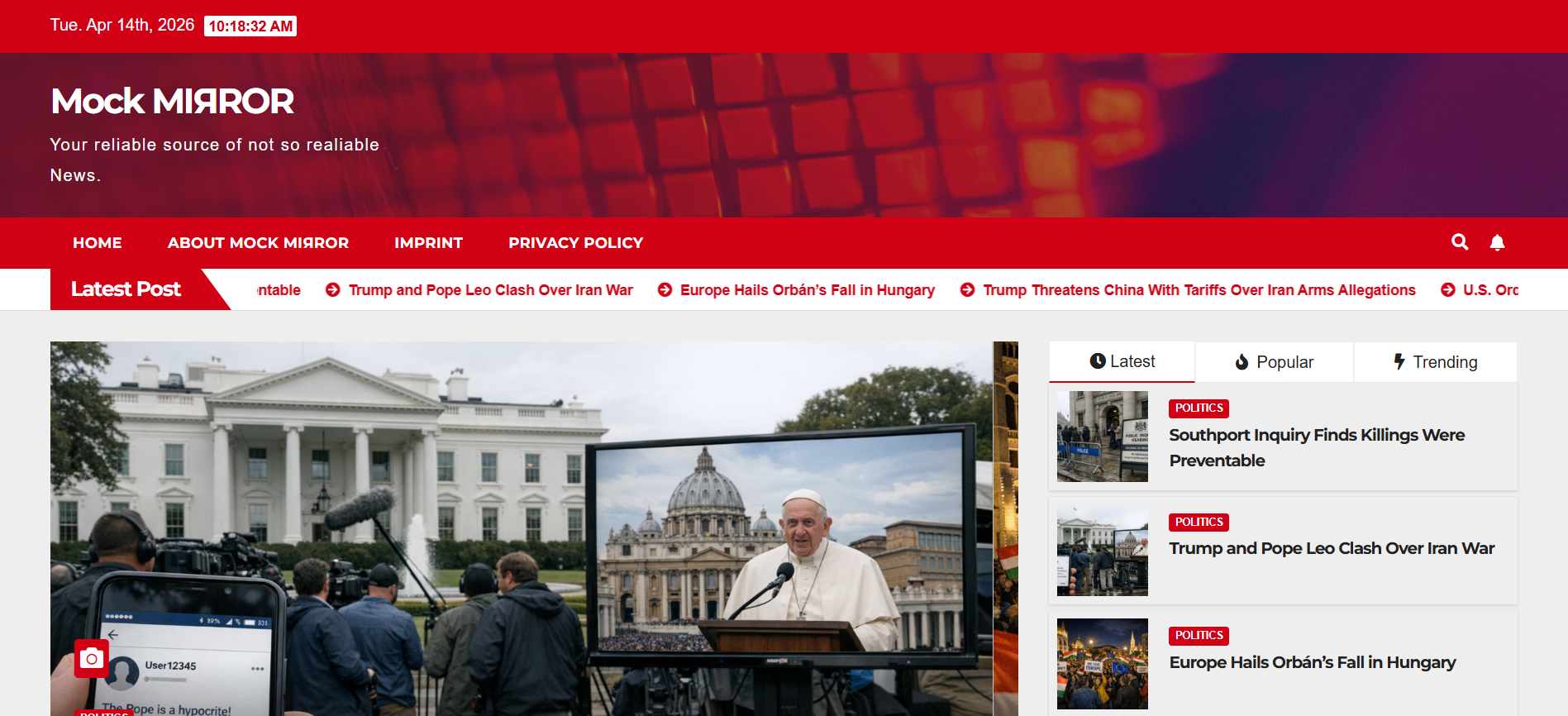
I revisited this experiment now, moving beyond the experiment on the edge of acceptability and well beyond trustworthiness: moving it towards something really useful: a self-run News Website, that get's updated fully autonomously, uses a variety of sources and does proper research on every article it writes. And here it is: MockMirror, v2.0
Exploring AI capabilities - and learn myself
Before going into more background, I don't want to tease you any longer, here is the link to Mock Mirror: https://mockmirror.thorstenkranz.de. But be careful: It comes without any warranty or guarantees.
On the Web, there are more than enough News websites. Also News aggregators are available, so there is no real gap I was trying to fill. I was driven by other ideas when building Mock Mirror.
MockMirror v1.0: The experiment
The initial version of Mock Mirror was developed back in 2023, when Generative AI was all the hype, yet maturity of tooling and ecosystems was rather low. It just read RSS feeds, wrote an article per entry (where a lot of details had to come from the LLM's aged world knowledge) and created the image with Dall-E 2. With limited quality, obviously.
Despite the limitations, MM 1.0 was the foundation and starting point. It nicely offered a glance on the impact of AI on Journalism (back then) ahead of us, and the risks of seemingly elaborate AI-produced content that lacks any substantial grounding.
MockMirror v2.0: Towards something really useful
In April 2026, I decided to revisit my little orphan. This time, I did not write code by hand anymore. Instead, I used my favorite AI coding agents to give it a major uplift.
- Upgrading to recent AI models
- Leveraging web research
- Aggregating multiple news items into a cluster of topics and then writing only one article for it
- Extend the research to an arbitrarily long list of RSS or Atom feeds, which wasn't meaningful before clustering
- Matching new content to recently written articles, and deciding if it is a new topic worth an article, an updated situation worth a follow-up or simply duplicate information
- Fully autonomous updates on a daily basis
The work invested was totally o.k.; a few evenings as a side activity, while working on other, more strategic things. The result? Something really useful for me. In a world of information overflow and lack of happiness with any of the existing news websites, I appreciate this degree of freedom. But more importantly: I learned. New things. Refreshed old knowledge. And was able to gauge my perception of opportunities and feasibilties in 2026.
Some technical details
Mock Mirror (MM) consists of two main architectural components.
- The Website: Nothing magical to be found here. A website based on the content management system Wordpress, using a free template, than runs on PHP and MySQL database. There are millions of similar setups.
- The Background process: Here the magic happens (citing Arthur C. Clarke: "Any sufficiently advanced technology is indistinguishable from magic"). A daily cron job runs, uses a variety of AI approaches and models and then updates the Wordpress website. And here, I will share some more details.
The background process is a multi-step workflow involving AI models for various purposes. The rough flow is as follows:
- Based on predefined sources, MM identifies relevant news cues that are relevant today. Currently, RSS feeds and X search is supported. It can combine a magnitude of sources to a pool of relevant topics.
- All the different news cues are clustered, to bring together related news bits, both within one source and across sources.
- In this process, MM includes the recent X articles it published within the last Y days, to avoid repetition and to have proper anchors for follow-up articles, taking into account what has been written before.
- Then, for each cluster that qualifies as new or follow-up, MM goes ahead and
- Does online research: using web search, a magnitude of additional online resources are used to provide additional information and context. If X is configured, it also searches additional evidence there.
- It classifies the article into the categories; these are defined in Wordpress and the app configuration to ensure proper tagging during publishing.
- MM then writes the article, where obviously, writing style is configurable.
- It creates a representative visual, that mostly is useless, but nice on first glance.
- Using the Wordpress REST API, the article is published automatically, including the image and the derived category
- For all configuration details AND the intermediate work artifacts, a MySQL database is being used. Storing configuration exclusively in the database enables a multi-instance setup, where different news cues are used for different target websites.
The code is written in Python, runs in Github Actions with dedicated environments for each instance. A typical run takes a few minutes and costs a few cents, depending on the model that is chosen.
Benefits and Implications
Besides the learning along the way, Mock Mirror, this really offers daily value for me very personally. I get a nice news feed ready to digest, without paywalls or ads. I also run a dedicated version only for AI news, which helps me stay up-to-date in this fast moving field and get ideas for my LinkedIn posts.
For companies, such a solution could be beneficial in multiple ways. What are your thoughts?